


What Adds Value to Your Home, and What Doesn’t
By Leigh Martinuzzi of Martinuzzi Group – eXp Realty | Sunshine Coast Real Estate
There’s a comfortable myth about renovating. Spend forty thousand dollars, and surely the home is worth forty thousand more.
It rarely works that way. Some improvements return well above what they cost. Others return a fraction. A few actively make a home harder to sell.
The difference usually comes down to one question. Are you renovating to suit the market, or to suit yourself? Both are perfectly valid reasons to spend money on your home. Only one of them reliably comes back in the sale price.
Three things that decide whether a renovation pays
Before any specific job, it helps to understand what’s actually going on underneath.
Every street has a ceiling. A home can only stretch so far above the typical value for its area. Lift a modest house well above everything around it and the market simply won’t pay the difference, however good the work is. This is the single most common way people lose money renovating.
Buyers pay to avoid work, not to inherit your taste. Broadly appealing, move-in-ready improvements win. Bold personal choices narrow the pool of people willing to pay for them, and a smaller pool means a softer price.
A refresh often gets you most of the way. A clever cosmetic update frequently achieves most of the visual lift of a full rebuild at a fraction of the cost. Before replacing anything, it’s worth pricing both options side by side. The gap between them is usually far larger than the difference buyers will actually pay.
What reliably adds value
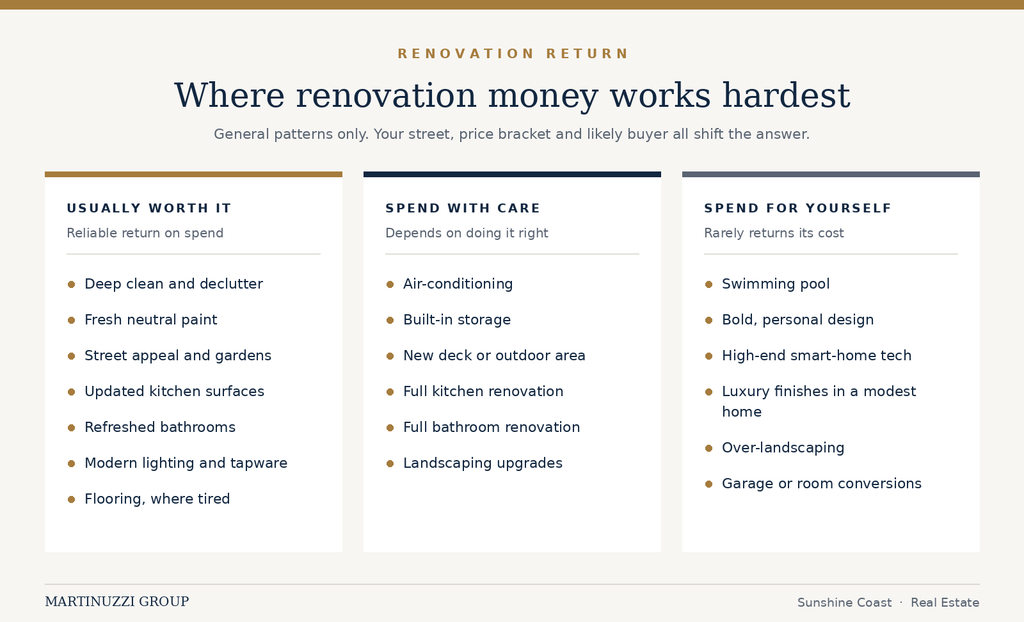
The pattern here is consistent. Low cost, broad appeal, makes the home feel newer, brighter and cleaner.
A deep clean and declutter costs almost nothing and makes rooms feel larger. Fresh neutral paint is the cheapest transformation available and instantly reads as cared for. Street appeal and tidy gardens set the price expectation before a buyer walks through the door.
Beyond that, updated kitchen surfaces do a lot of work. A new benchtop and handles can give you the look of a new kitchen for a small share of the cost. Refreshed bathrooms follow the same logic, where new grout, tapware and lighting lift a dated room cheaply. Modern light fittings and tapware throughout are a small spend with outsized impact on how current a home feels.
If flooring is genuinely tired, replacing it modernises a home immediately.
None of these is exciting. All of them are reliable.
Where it depends on getting it right
This is the middle ground, and it’s where most renovation money is won or lost.
Air-conditioning has broad appeal and is increasingly expected, so it generally does well if installed sensibly. Built-in storage pays if it’s modest, since buyers love storage, though it’s easy to over-engineer and overspend. A new deck or outdoor area can be strong in our climate, provided it suits the home and the budget.
Full kitchen and bathroom renovations are the genuinely variable ones. In a higher-value home, a full kitchen renovation can pay. In a modest one, it often doesn’t, and a refresh would have achieved most of the result. A full bathroom renovation is worth it when the room is actually failing. When it’s merely dated, refresh first.
Landscaping sits here too. Tidy and green pays. High-maintenance gardens frequently don’t, because buyers see future work rather than added value.
The outcome in this middle group swings on your price bracket and the quality of the work, which is exactly why a conversation before committing is worth more here than anywhere else.
What rarely comes back
Here’s the part most people would rather not hear.
Swimming pools are the clearest example. High cost, ongoing maintenance and insurance, and they genuinely divide buyers. Some will pay more for one. Others will deduct for it. On the Sunshine Coast a pool is more common and more wanted than in colder parts of the country, but it still rarely returns what it costs to install.
Bold, personal design narrows your buyer pool, because taste rarely transfers to the next owner. High-end smart-home technology dates quickly and most buyers won’t pay extra for it. Luxury finishes in a modest home run straight into the street ceiling. Over-landscaping reads as future maintenance.
Garage or room conversions deserve a special mention, because they can actively remove something buyers want. Converting a garage gains you a room and loses you parking, and in a lot of markets parking is worth more.
Renovating for yourself is a perfectly good reason
Worth saying clearly, because none of the above means don’t do it.
If you’re going to live in the home for another ten years and a pool would transform how your family uses the place, that’s a genuinely good reason to build one. The same goes for a kitchen built exactly to your taste, or a garden you’ve always wanted.
Just budget it as a lifestyle decision rather than an investment. The mistake isn’t spending money on your own enjoyment. The mistake is spending it expecting the sale price to repay you later.
The order that works
If you’re preparing to sell and want the spending to count, the sequence matters more than the budget.
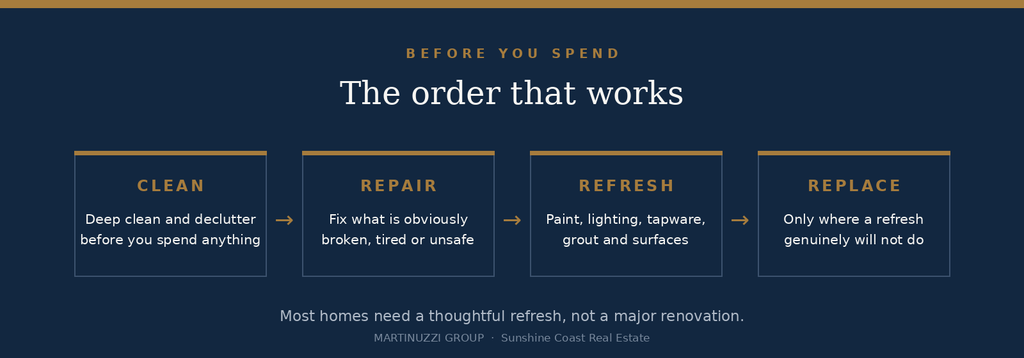
Clean and declutter first, before you spend anything at all. Then repair what’s obviously broken, tired or unsafe. Then refresh, meaning paint, lighting, tapware, grout and surfaces. Only then consider replacing anything, and only where a refresh genuinely won’t do.
Most homes need a thoughtful refresh, not a major renovation.
Know your ceiling before you spend
The honest answer to what adds value to your home depends on your street, your price bracket and your likely buyer. The same renovation can be a good idea in one suburb and a poor one three streets away.
That’s worth knowing before the money is committed, not after. We’re always glad to walk through a property and give you a straight view on where your street’s ceiling sits, which jobs your buyers will actually pay for, and what to leave alone entirely. No obligation, and no pressure to sell.
It’s a free conversation that routinely saves people tens of thousands.
Want the full picture?
Our guide sorts common renovations into three clear zones with typical returns for each, plus a simple three-question test to run any job through before you commit.
Read The Renovation Return Map
Get in touch with us today and and let’s give you fantastic results that you deserve.
SUBSCRIBE to stay up to date with all the latest property insights and news.
Click Here to Subscribe
The Sunshine Coast Seller’s Guide to Choosing the Right Agent
Get Your Free Guide Here
Just Listed Your Home? Here’s What Happens Next (And How to Get Ready for a Great Result)
Download the Guide Here
This article is general information only and does not constitute financial, legal or tax advice. Martinuzzi Group does not provide financial, legal or tax advice and does not recommend specific products, lenders or structures. Always seek advice from licensed professionals tailored to your circumstances before making any commitment.