

The RBA Raised Rates Again. Why I Still Think Supply Is the Real Fix
By Leigh Martinuzzi of Martinuzzi Group – eXp Realty | Sunshine Coast Real Estate
Last week I said I thought the Reserve Bank would hold. I was wrong, and that’s okay. A prediction is just that, and I would rather share an honest view than sit on the fence.
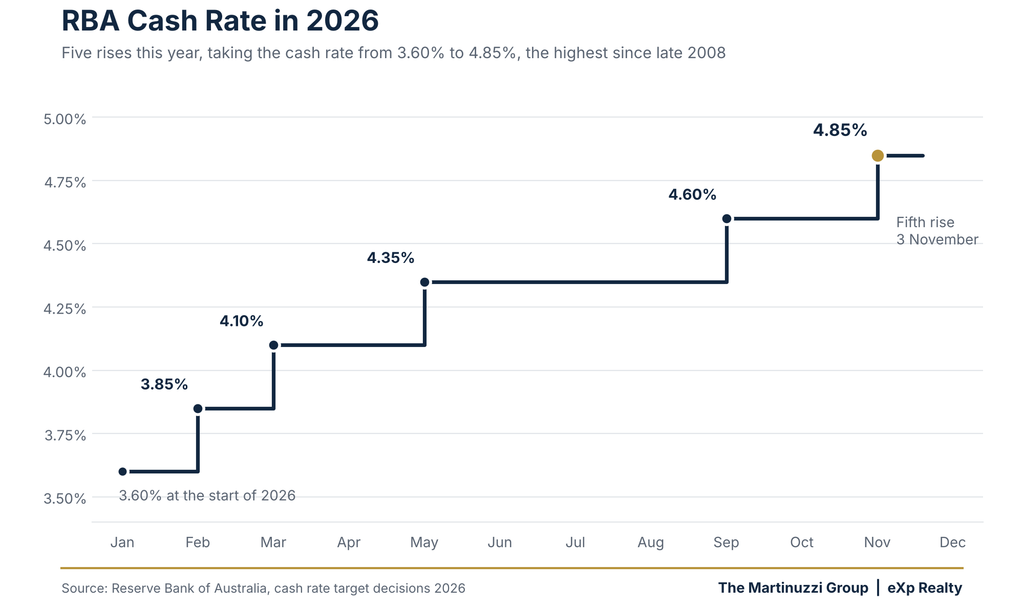
On Melbourne Cup Day, the RBA lifted the cash rate by 0.25% to 4.85%. That is the fifth rise this year and the highest cash rate since late 2008.
What interested me most was that the decision was not unanimous. Six board members voted for the increase, while three voted to keep rates on hold at 4.60%. So I wasn’t entirely alone in my thinking.
Below, I explain what the decision could mean for homeowners, sellers and buyers here on the Sunshine Coast, and why I still believe higher rates alone won’t solve Australia’s housing problem.
Why the RBA Moved Again
The RBA’s main concern is that inflation is taking longer to come down than it expected. Its updated forecasts have inflation staying elevated through much of 2027 and not reaching the top of the 2 to 3% target range until late 2027, about three quarters later than it previously expected. Part of that comes from fuel and commodity prices linked to the Middle East conflict, but the RBA also judged that the economy had been running a little hotter than it first estimated.
I covered the September inflation figures in detail last week, so I won’t repeat them here. The short version is that the essentials are still getting more expensive, and families are feeling it.
For mortgage holders, the cost keeps adding up. According to Canstar, this latest rise adds about $92 a month for a borrower with a $600,000 loan and 25 years remaining. Across all five hikes this year, that same borrower is paying around $456 more each month than they were in February.
Higher Rates Won’t Build More Homes
This is where my view differs from the RBA’s approach.
Interest rates are a blunt tool. They work by slowing spending, and they are certainly doing that. Mortgage holders are tightening their belts, and first home buyers are finding it harder to get a foot in the door.
But much of what is driving housing costs is not something interest rates can fix. Australia simply has not built enough homes for the people who need them.
The RBA’s own statement makes the point. It expects higher interest rates, along with falling property prices and turnover, to weigh on growth in dwelling investment. In plain terms, rate rises are likely to slow home building at a time when we need much more of it.
We are already behind. Under the National Housing Accord, governments committed to building 1.2 million new homes, and the National Housing Supply and Affordability Council’s latest quarterly report now estimates that target won’t be reached until the December quarter of 2030. The original deadline was June 2029.
When builders face higher finance costs and buyers become more cautious, new projects get harder to start. Fewer homes being built today could mean tighter supply, and more pressure on prices and rents, a few years from now.
My view is that until we get serious about housing supply, including planning, approvals, construction costs and labour, we will keep coming back to the same problem. The RBA can only work with the tool it has. Fixing supply needs a much broader effort.
What the National Market Is Showing
The rate rises are already showing up in property values. Cotality’s national Home Value Index fell 1.2% in October, the seventh monthly decline in a row, leaving values 6.7% below their March peak.
The combined capital cities have fallen 8.1% in seven months, which Cotality says is the fastest pace of decline in the past 40 years. Brisbane and Perth have now overtaken Sydney with the fastest rate of decline, with Brisbane values down 2.0% in October alone.
That matters for us here. Many of the buyers who move to the Sunshine Coast come from Brisbane and Sydney. When those markets soften, it can have a flow-on effect locally. It may not be as sharp as what the capitals are experiencing, but I think it is worth being aware of.
What It Could Mean for Homeowners
If you have a mortgage, it may be a good time to check where you stand. Look at your rate, your repayment buffer and whether a conversation with your lender or broker makes sense. Lenders are now confirming when they will pass on the rise, with Macquarie, for example, lifting its variable home loan rates by 0.25% from 19 November.
Many longer-term homeowners are likely still sitting on solid equity after the strong growth of recent years. A softer market doesn’t change that, but it does make it worth understanding your property’s current position before you plan an upgrade, downsize or sale.
What It Could Mean for Sellers
This is a market where strategy matters more than ever.
Nationally, Cotality reports that the median time on market has stretched to 39 days, the longest since August 2020, while average vendor discounting has reached 4.7%, the largest since May 2019. Buyers have more choice and more time to decide.
That is why getting the price right from the start is so important. Sales from six or twelve months ago are not a reliable guide when the market is moving.
I have seen this locally in recent weeks. Some properties come to market at a high price, whether that’s the owner’s expectation or a price promised by an agent, and then sit for three or four months. When they finally sell, the result can be $100,000 to $200,000 below the original asking price. Often that is a figure the seller could likely have achieved at the start of the campaign, and in some cases they may have done better.
Realistic pricing, strong presentation and a clear plan from day one can help you avoid a longer campaign and a lower result.
What It Could Mean for Buyers
For buyers, there may be more room to negotiate. With less competition, you may also have more time to make decisions.
That doesn’t mean bargains everywhere. Most sellers who are not under pressure to sell are unlikely to drop their price dramatically.
Borrowing capacity is the other big factor. Canstar estimates that after five rate rises, an average income earner’s maximum borrowing capacity has fallen by about 11% across 2026. As a rough guide, someone who could borrow $1 million at the start of the year may now be looking at somewhere around $890,000.
If you are already pre-approved, it is worth checking with your broker or bank to see where your assessment now sits and how long your approval has left to run.
The Sunshine Coast Angle
The Sunshine Coast is still a wonderful place to live, and that long-term appeal hasn’t gone anywhere. But buyers are watching their budgets closely, and the gap between a well-judged price and an optimistic one is showing up in results.
Supply matters here too. Our region keeps attracting people from interstate and from Brisbane, and the question of where they will all live does not go away when interest rates rise. That is why I believe the bigger conversation needs to be about building more homes, not just making borrowing more expensive.
Let’s Talk
If you are wondering what this latest rate rise could mean for your property, whether you are buying, selling or simply planning ahead, I would be happy to share my thoughts. A quick, no-pressure conversation can give you more clarity before making any big decisions. Feel free to reach out to me or the team at The Martinuzzi Group anytime.
Get in touch with us today and and let’s give you fantastic results that you deserve.
SUBSCRIBE to stay up to date with all the latest property insights and news.
Click Here to Subscribe
The Sunshine Coast Seller’s Guide to Choosing the Right Agent
Get Your Free Guide Here
Just Listed Your Home? Here’s What Happens Next (And How to Get Ready for a Great Result)
Download the Guide Here