


June 2026 Property Market Update: A Softer National Market, But Not One Story
By Leigh Martinuzzi | Martinuzzi Property Group – eXp Australia
The Australian property market has moved into a more cautious phase. Not a crash. Not panic. Not the dramatic headline version that tends to get attention. But a clear and meaningful deceleration.
At the start of June 2026, the national picture is being shaped by several forces arriving at once. The cash rate is now sitting at 4.35%. Affordability and serviceability are stretched close to their limits for many households. Consumer confidence has weakened further, accelerated by broader global uncertainty, including the Iran conflict. And from July 2027, Federal Budget changes to negative gearing on existing properties are expected to reshape parts of the investor market.
That does not mean every market is falling. What we are seeing is a highly fragmented, two-speed property market. Some parts of the country are already moving backwards. Others are still growing, but at a slower pace. And a few regional lifestyle markets, including the Sunshine Coast, continue to show impressive resilience because the underlying fundamentals remain tight.
In my view, this is where homeowners need to be careful with national headlines. They can give useful context, but they rarely tell the full local story. A seller in Melbourne, a buyer in Perth, and a homeowner here on the Sunshine Coast are not all dealing with the same market.
So the better question is not simply, “What is the Australian property market doing?”
The better question is, “What is happening in my suburb, my price bracket, and my property type?”
The National Market Has Stalled, But the Detail Matters
According to Cotality’s latest figures, the national Home Value Index was flat in May, recording 0.0% growth for the month. On the surface, that sounds simple. But underneath that flat national result is a much more uneven story.
As shown in the capital city performance table below, conditions now vary sharply across the major cities. Sydney and Melbourne are already moving backwards, while Perth, Darwin and Brisbane are still recording growth.
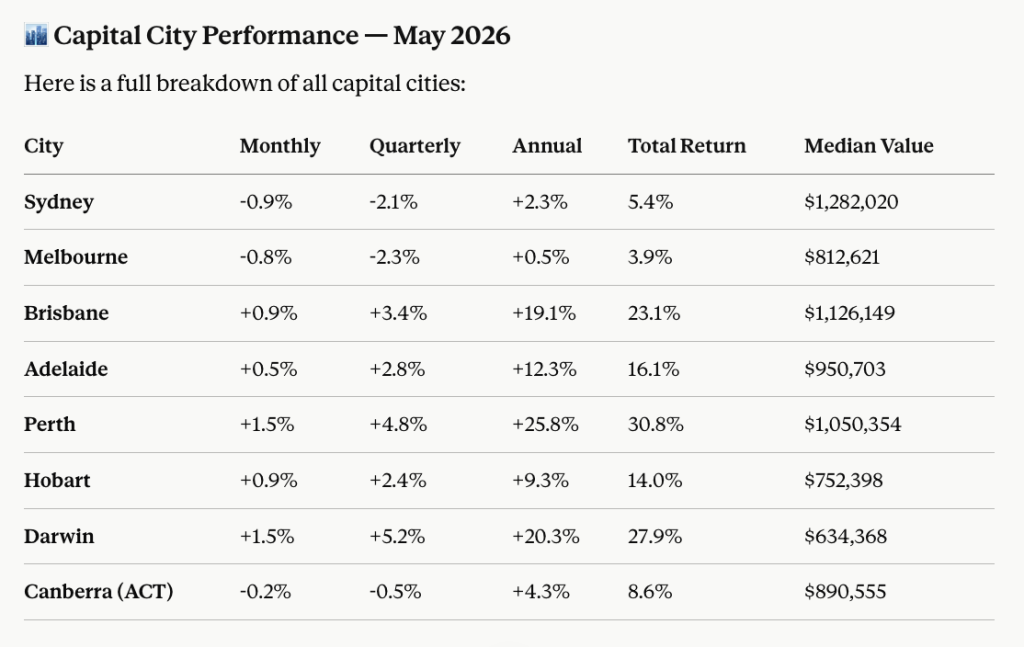
Sydney and Melbourne are now leading the downturn. Sydney values fell 0.9% in May and are now 2.1% below their November 2025 peak. Melbourne fell 0.8% for the month and sits 2.9% below its November 2025 high. Canberra also softened, down 0.2% in May. At the other end of the market, Perth and Darwin both rose 1.5% for the month. Brisbane increased by 0.9%, and Adelaide rose by 0.5%.
That is why I keep coming back to the same point: there is no single Australian property market.
Cotality Research Director Tim Lawless made a useful observation on this, noting that Perth values have surged 91.4% since May 2021, while Melbourne values are only 3.3% higher over the same period. That is an enormous gap between two major capital cities.
From a Sunshine Coast perspective, this matters because national media often treats the market as if it moves in one clean direction. It does not. A seller in Melbourne is dealing with a very different set of conditions to a seller in Brisbane, Perth or the Sunshine Coast.
The question is not, “What is the Australian market doing?”
The better question is, “What is happening in my suburb, my price range, and my property type?”
The Slowdown Has Been Building for a While
I would be careful not to blame the current softness on one single factor. Yes, interest rates matter. Yes, the Federal Budget changes matter. Yes, consumer confidence matters. But according to Cotality, the loss of momentum had already been building before the latest rate rises, before the Budget announcement, and before the Iran conflict added another layer of uncertainty.
Most cities saw their strongest growth phase through spring last year. Since then, affordability and serviceability have been doing what they always do when buyers reach their limits. They slowly reduce demand. That is now showing up in sales activity.
Nationally, estimated home sales over the past three months are tracking 2.2% lower than a year ago and 4.1% below the five-year average. The largest falls are in Sydney and Melbourne, where sales are down 17.0% and 14.2% respectively compared with the same period last year.
That tells me buyers in those markets are becoming more cautious. Listings have also risen above average levels in those cities, which gives buyers more choice and more negotiating power. Clearance rates across the capitals have also softened, with the weighted average sitting close to 50%.
There is another detail I think is worth watching. Lower-priced properties have generally held up better over the past few years because they attracted more demand from buyers chasing relative affordability. But even that part of the market is now showing signs of strain in some cities. Cotality noted that lower quartile houses are now falling in Sydney and Melbourne, while Canberra is seeing falls across both lower quartile houses and units.
That matters because when weakness spreads into the lower price points, it shows affordability pressure is no longer isolated to prestige or discretionary buyers. It is reaching the broader market. For Sunshine Coast sellers, this does not mean panic. But it does mean strategy matters more. Buyers are still active here, but they are not reckless. Presentation, pricing, timing and negotiation are becoming more important, not less.
Regional Markets Are Still More Resilient, But They Are Not Immune
Regional markets have been one of the stronger parts of the Australian property story, and they continue to hold up better than many capital city markets. Cotality’s regional data shows combined regional values rose 0.6% in May. That is still positive, but it was also the smallest monthly rise in a year. In other words, regional markets are still moving, but the pace is easing. Regional WA led the country with a 1.9% monthly gain, while Regional NSW recorded the smallest rise at 0.2%.
The broader regional update shows a clear divide. WA and Queensland regional markets remain among the strongest, supported by demand, migration and limited supply. On the other hand, some higher-value regional lifestyle markets are starting to hit affordability ceilings.
Bowral-Mittagong is a good example. It recorded a 1.2% fall over the quarter, with annual growth sitting at 0.0%. That is a reminder that lifestyle appeal alone does not make a market bulletproof. If prices run too far ahead of local incomes, if listings rise, or if buyer demand thins out, even desirable markets can stall.
This is one of the reasons I think the Sunshine Coast needs to be looked at carefully rather than lazily grouped in with every other regional lifestyle market. We do have lifestyle appeal, absolutely. But the local market is also being supported by population movement, limited available housing, a strong owner-occupier base, and ongoing demand from people who genuinely want to live here.
The Sunshine Coast Is Still Strong, But I Would Not Call It Easy
Locally, the Sunshine Coast continues to show strong numbers.
According to Cotality’s regional market data, the Sunshine Coast median dwelling value now sits at $1,262,981. The region recorded a 3.7% quarterly gain and 14.6% annual growth. Those are not soft market numbers.
But I think we need to understand what is really driving them. This is not simply an affordability story. The Sunshine Coast median is now higher than Brisbane’s median dwelling value of $1,126,149. So buyers are not coming here because it is cheap.
They are coming here because they want the lifestyle, the space, the community, the climate, the schools, the beaches, the hinterland, the village feel in places like Palmwoods and Woombye, and the long-term scarcity that comes with a tightly held region.
Cotality’s regional commentary points to internal migration and under-supply as key drivers of regional strength. That fits what I am seeing on the ground. The Sunshine Coast still has more demand than available quality stock in many pockets.
The selling conditions support this. The median time on market is sitting at 27 days, and vendor discounting is only 1.7%. To me, that says buyers are still prepared to act when the property is right and the pricing is sensible. But I would still be careful.
A strong market does not mean every property sells easily. Buyers are more informed now. They are comparing value more closely. They are watching interest rates. They are asking better questions. And they are less forgiving when a property is overpriced, poorly presented or launched without a clear strategy.
The best homes, priced correctly and marketed well, can still attract strong competition. But average campaigns are more likely to be exposed in this next phase.
Investors Are Active, But the Yield Story Is Tight
The investor side of the market is also worth talking about honestly. Cotality’s lending commentary shows total housing loan commitments fell 6.2% in the March quarter. That tells us overall borrowing activity has weakened. But owner-occupiers pulled back faster than investors, which pushed the investor share of total lending to a record 41.0% by volume.
In my view, some of that activity is likely investors moving ahead of the Federal Budget changes due from July 2027, when negative gearing on existing properties is expected to be limited. But this does not mean investing has suddenly become easy.
On the Sunshine Coast, gross rental yields are sitting at 3.4%. That is low. In fact, it places us among the lowest-yielding major regional markets, alongside places such as Bowral-Mittagong and Busselton.
That does not mean the Sunshine Coast is a bad investment market. It means it is a capital growth market more than a cash flow market. There is a big difference.
If investor mortgage rates are around 6.3%, and you then add insurance, rates, maintenance, property management and other holding costs, a 3.4% gross yield does not leave much room for positive cash flow. Investors buying locally need to be clear on that.
The Sunshine Coast investment case is usually about the quality of the asset, the scarcity of the location, the depth of long-term demand, and the potential for capital growth over time. It is generally not about buying a property and expecting the rent to comfortably cover everything from day one. That is not a reason to avoid investing here. It is simply a reason to run the numbers properly.
What This Means for Sellers and Buyers
For sellers, I think this is a market that rewards realism. If you own a quality property in a tightly held Sunshine Coast location, you may still be in a strong position. Limited supply continues to support values, and serious buyers are still active. But the margin for error is smaller than it was during the hottest parts of the market. Overpricing can still hurt a campaign. Poor presentation can still cost money. Weak follow-up can still lose buyers. And assuming the market will do all the work is risky.
In my view, the best approach right now is not aggressive hype. It is clear evidence, good preparation, strong marketing, and a pricing strategy that creates confidence.
For buyers, the picture is mixed.
In Sydney and Melbourne, rising listings and weaker sales volumes may be giving buyers more room to negotiate. On the Sunshine Coast, it depends heavily on the suburb and property type. If you are waiting for a major local correction, I would be cautious with that assumption. The Sunshine Coast still has strong underlying demand and limited supply in many segments.
But that does not mean buyers should rush either. The smarter approach is to know your borrowing capacity, understand comparable sales, look carefully at property fundamentals, and be ready to act when the right property appears. In this market, hesitation can still cost you on the right property, but overpaying for the wrong one can also be painful.
Final Outlook
My read on the market at the start of June 2026 is this: Australia has entered a softer, more uneven phase.
Sydney and Melbourne are already under pressure. Perth, Darwin and Brisbane are still growing. Regional markets remain supported, but momentum is easing. And the Sunshine Coast continues to show strength because the local fundamentals remain tight. But the next phase will not reward lazy thinking.
For homeowners, the national headlines are useful context, but they are not enough. What matters most is your specific property, your suburb, your competition, your buyer pool, your timing and your reason for making a move.
That is where the real clarity comes from.
If you are thinking about selling, refinancing, investing, downsizing, or simply wanting to understand how much equity you may now have, I am happy to provide a personalised, suburb-specific property update or appraisal.
Not a computer-generated guess. Not a broad national opinion. Just a clear look at your property, the local evidence, and what it could realistically achieve in today’s market.
Request Your Free Market Appraisal Today! 👉 Click here to book your appraisal
SUBSCRIBE to stay updated with all latest property insights and news 👉 Click Here to Subscribe
The Sunshine Coast Seller’s Guide to Choosing the Right Agent 👉 Get Your Free Guide Here
Preparing for Settlement: A Seller’s Guide to a Smooth Handover 👉 Download the Guide Here