


Why Micro-Markets Matter More Than Ever on the Sunshine Coast
By Leigh Martinuzzi | Martinuzzi Property Group – eXp Australia
Over the past week, I’ve been going through the latest housing data and market commentary, and the big takeaway for me is this: the Australian property market is no longer moving as one.
More and more, we’re seeing a market made up of smaller micro-markets, each responding differently to supply, affordability, buyer demand, and local lifestyle appeal. That matters here on the Sunshine Coast, because broad national headlines only tell part of the story.
What really shapes outcomes in this region is often far more specific: the suburb, the street, the property type, and the buyer profile behind the enquiry. In my view, that is exactly why local knowledge matters more now than it has in quite some time.
Nationally, the market still has strong foundations. But it is also becoming more selective. Some areas are still performing exceptionally well, others are flattening out, and buyers are becoming more deliberate in how and where they act. Here on the Sunshine Coast, that means quality, scarcity, and positioning are continuing to stand out.
The national market is still growing, but the gap is widening
According to Cotality’s April Housing Chart Pack, Australia’s residential market is now worth $12.6 trillion. National dwelling values rose 2.1% over the March quarter and 9.9% over the year to March, which is the fastest annual pace since mid-2022.
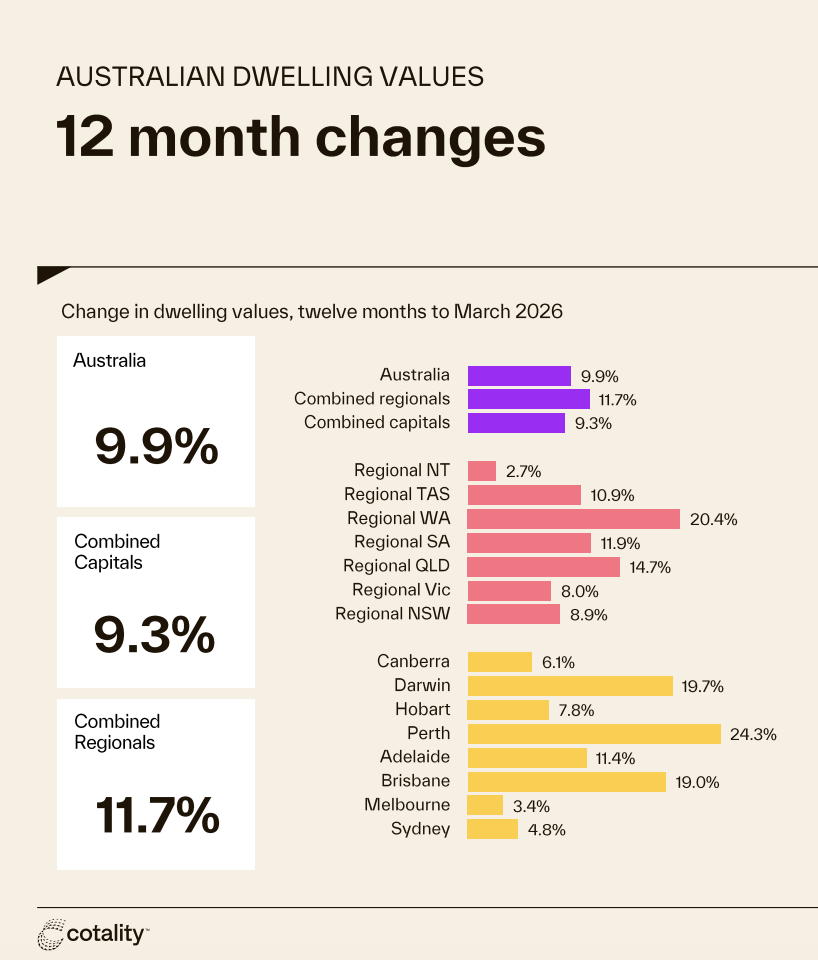
At the same time, the market is clearly splitting. Sydney and Melbourne are showing signs of slowing, with Melbourne down 0.2% in March, while Brisbane and Perth continue to perform strongly. Brisbane is up 19.0% annually and Perth is leading the country at 24.3% annual growth.
To me, that says we need to be careful about relying too heavily on one national headline. This is now a more fragmented environment, and that creates very different conditions depending on where you are and what type of property you are talking about.
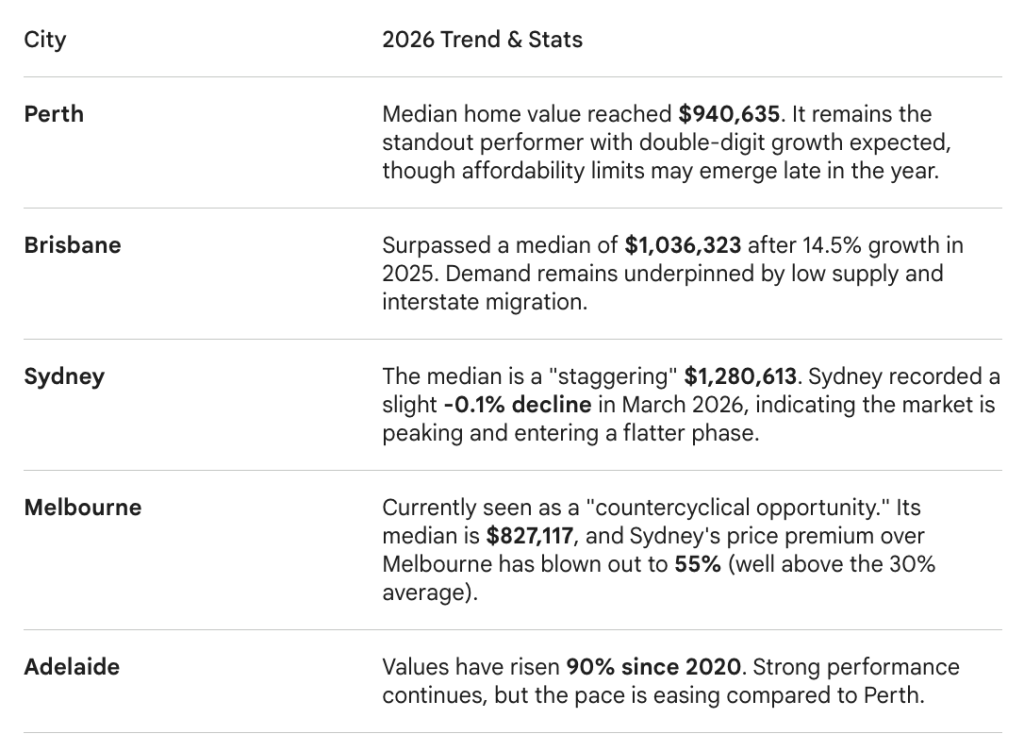
Queensland is a perfect example of that. The state has accounted for 25% of national population growth, but less than 20% of new dwelling completions. That imbalance helps explain why supply continues to play such a big role in supporting values across many Queensland markets.
Supply is still doing a lot of the heavy lifting
If there is one theme that keeps coming through in the data, it is scarcity.
New listings remain below average, transaction volumes are still running above the five-year average, and national median time on market sits around 30 days, which tells us homes are still moving, even if buyers are taking a bit more care with their decisions.
That does not suggest a market that has stalled. It suggests a market that has become more discerning.
Buyers are still active, but they are more selective. Sellers can still achieve very strong outcomes, but those outcomes are increasingly tied to preparation, presentation, pricing, and strategy. In other words, the market is still working, but it is rewarding quality more clearly.
That is very relevant here on the Sunshine Coast. Good homes in good positions are still attracting attention, but buyers are not responding to everything equally. They are looking harder at value, location, condition, and whether a property suits their needs both now and in the future.
Long-term ownership is still being rewarded
Another result that really stood out to me this week came from Cotality’s latest Pain & Gain report.
One of the more telling data points for me this week was that 95.9% of resales in the December 2025 quarter made a gross profit, the strongest result in 20 years.
What also stood out was the hold period. Profitable sellers had typically owned their property for a median of 9.2 years, while loss-making sales were far more common among those who had bought closer to the COVID-era peak and sold too soon.
To me, that reinforces something many long-term owners already understand: time in the market still matters.
Yes, cycles change. Yes, conditions tighten and loosen. But quality property, held over time, still tends to reward patience. That is an important message in a market where there is often too much focus on short-term noise.
The report also showed a clear gap between houses and units. Houses continue to outperform on resale profitability, which is not surprising given how strongly buyers still value land content, flexibility, and long-term scarcity.
Interest rates are still influencing behaviour
Interest rates remain part of the story, and that cannot be ignored. The cash rate is now 4.10%, and that continues to shape borrowing capacity, confidence, and affordability.
But I do not think rates alone explain what is happening.
Recent commentary around the market has highlighted the growing divide between equity-rich buyers, such as upgraders and downsizers, and first-home buyers who are more constrained by borrowing limits and cost-of-living pressures. That is one of the reasons the market is splintering more noticeably.
Some segments are still moving confidently because buyers in those parts of the market have equity, flexibility, and stronger financial positions. Other segments are becoming more price sensitive because buyers are working within tighter borrowing limits.
That is another reason why micro-markets matter so much right now. The impact of rates is not being felt evenly.
Why this matters on the Sunshine Coast
The Sunshine Coast is still very much a lifestyle-driven market, and lifestyle markets often behave differently from purely transactional ones. For many buyers, this region is not just a numbers decision. It is a location decision, a lifestyle decision, and often a long-term decision.
That does not mean every part of the Coast moves the same way. It definitely does not.
Premium beachside homes, family properties in established suburbs, low-maintenance homes for downsizers, and investor-grade apartments are all being judged differently by buyers at the moment. Some are benefiting from stronger demand and tighter supply. Others are facing more scrutiny.
That is why I think the micro-market conversation is so important. Even within one region, there can be meaningful differences in demand, competition, and price growth depending on the suburb and the asset.
If I had to sum up the local market in one sentence, it would be this: quality still stands out.
Well-located homes, tightly held neighbourhoods, practical floorplans, and properties that suit the way people want to live today are still the ones that tend to perform best.
Buyers are becoming more selective about what they value
It is not just a question of house versus unit. Buyers are looking more closely at walkability, convenience, low-maintenance living, and whether a property supports changing household needs.
One of the broader shifts I think is worth watching is that around 70% of new growth is now occurring within established urban areas, which is reshaping older neighbourhoods and putting more focus on convenience, connection, and amenity.
At the same time, there is growing demand for what is often called the “missing middle”, townhouses, duplexes, villas, and manor-style housing that sit between high-rise apartment living and the traditional detached family home. For many buyers, that middle ground offers the right balance of lifestyle, manageability, and location.
Buyers are also voting with their feet. Walkable suburbs, those with easier access to cafes, parks, schools, and transport, are commanding a clear premium over more car-dependent locations. That says a lot about where buyer preferences are heading.
On the Sunshine Coast, this makes a lot of sense. Demand remains strong for homes close to beaches, village centres, schools, medical precincts, and everyday amenity. Buyers still care about lifestyle, but increasingly they also care about convenience and liveability.
That is one reason well-connected, walkable locations are continuing to hold their appeal.
Navigating the 2026 Forecast
As we look toward the second half of the year, I think the market is being shaped by two primary forces: equity and scarcity.
The first is the equity advantage. Equity-rich buyers, particularly downsizers and upgraders, are still driving a large part of the market. Because they are less sensitive to interest rates than first-home buyers, they are continuing to compete for quality A-grade properties and helping keep demand firm in the better-performing segments.
The second is the supply floor. Building approvals remain low, and in states like Queensland and Western Australia, the gap between population growth and new home completions is still significant. That ongoing mismatch is creating a natural layer of support for property values, especially in markets where lifestyle demand and limited quality stock are already doing a lot of the heavy lifting.
From my perspective, that is why the market has remained more resilient than many expected. Affordability is clearly becoming more of a factor, but equity and scarcity are still underpinning activity in the right locations and for the right types of property.
What It Means for Buyers, Sellers, and Investors
For sellers, the outlook remains positive. If you have held your property for several years, there is a good chance you are sitting on historically strong equity. For many owners, that creates a valuable springboard for the next move, whether that means upsizing, downsizing, investing, or repositioning for a lifestyle change.
For buyers, the key is to focus less on the broad national story and more on lifestyle, scarcity, and location. In my view, the most resilient demand is still being found in well-located lifestyle suburbs where supply remains tight and liveability remains high. Walkability, convenience, and access to amenity are becoming more important, not less.
For investors, the rental backdrop continues to provide support. With vacancy rates sitting around 1.6%, rental supply remains constrained, and that is helping support yields in the right parts of the market. I think the better opportunities are still likely to be found in quality properties with owner-occupier appeal, particularly boutique-style developments and well-located assets in tightly held areas.
My Final Thoughts
My overall view this week is that the market still has strong foundations, but it has become more selective.
Nationally, values are still rising, long-term ownership is still being rewarded, and supply remains a major issue, particularly in Queensland. But the gap between stronger and weaker markets is widening, and broad headlines are no longer enough on their own.
Here on the Sunshine Coast, I think that means quality, strategy, and local knowledge matter more than ever.
This remains a market with strong lifestyle appeal, limited quality supply, and long-term demand drivers in its favour. But it is also a market where buyers are more deliberate, sellers need to be well advised, and outcomes will increasingly depend on the suburb, the asset, and the way a property is taken to market.
If you’d like help navigating the market, whether you’re buying, selling, or just planning ahead, feel free to reach out.
At Martinuzzi Property Group, we’re here to deliver more than a sale. We guide you with radical honesty, exceptional communication, and a stress-free experience, backed by calm confidence, local expertise, and genuine care so you feel informed, supported, and in control from day one to sold.
If you’d like a clear, no pressure view of what your home could achieve in today’s market and what you can do to maximise the outcome, I’m happy to help.
Request Your Free Market Appraisal Today! 👉 Click here to book your appraisal
SUBSCRIBE to stay updated with all latest property insights and news 👉 Click Here to Subscribe
The Sunshine Coast Seller’s Guide to Choosing the Right Agent 👉 Get Your Free Guide Here
Preparing for Settlement: A Seller’s Guide to a Smooth Handover 👉 Download the Guide Here
Sources and Market Data
- https://www.cotality.com/au/insights/articles/monthly-housing-chart-pack-april-2026
- https://www.cotality.com/au/insights/articles/housing-resale-profits-hit-highest-level-in-20-years-as-median-gain-reaches-record
- https://propertyupdate.com.au/property-news-headlines-forecasts
- https://propertyupdate.com.au/how-our-suburbs-will-change-the-future-of-australian-cities
- https://propertyupdate.com.au/the-australian-property-market-is-splintering-and-most-people-havent-noticed