


Inflation Jumps to 4.3%: Why I Think the RBA May Hold Next Week
By Leigh Martinuzzi of Martinuzzi Group – eXp Realty | Sunshine Coast Real Estate
When the latest inflation figures came out yesterday, I’ll be honest, they made me a little nervous.
The Australian Bureau of Statistics (ABS) released its monthly Consumer Price Index on Wednesday 28 October, and annual inflation came in at 4.3% for the year to September. That is up from 4.0% just a month earlier, and well above the Reserve Bank’s target range of 2 to 3%.
The RBA board meets next Monday and Tuesday, and most economists now expect a fifth rate rise for 2026. My feeling is they will hold. Below, I explain why, and what it could mean for homeowners, sellers and buyers here on the Sunshine Coast.
What the Latest Inflation Figures Show
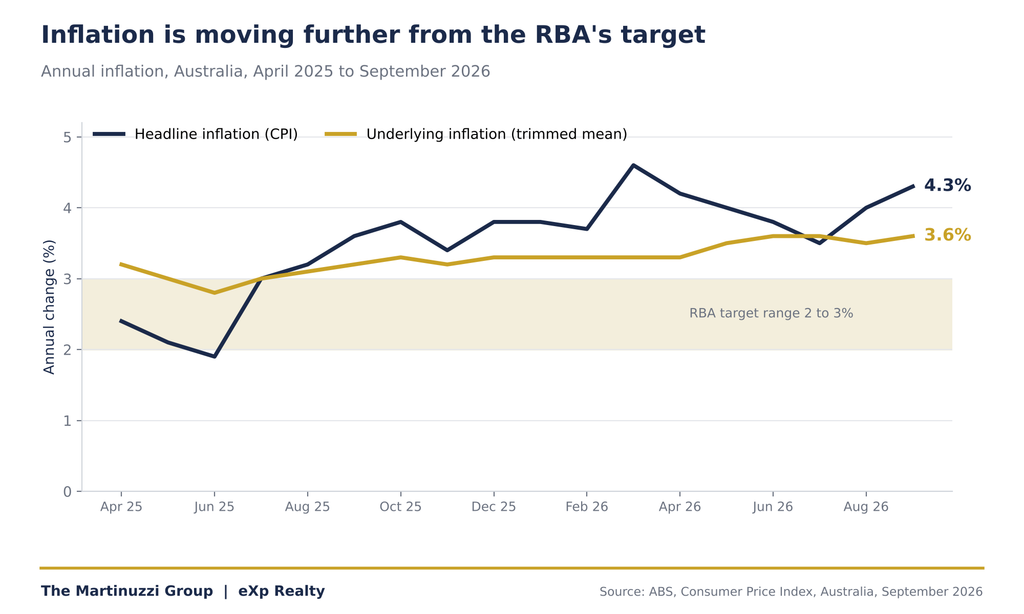
Prices rose 0.8% in September alone. The RBA’s preferred measure of underlying inflation, known as the trimmed mean, also edged up to 3.6%. The trimmed mean removes the biggest price swings each month, so it gives a clearer picture of whether price pressure is spreading through the economy.
Housing costs have a big part to play. Housing was again the largest contributor to inflation, rising 5.2% over the year. That includes new home building costs, up 4.7% as builders pass on higher labour and material prices, electricity, up 12.8% largely because Commonwealth rebates have ended, rents, up 3.6%, and council rates and charges, up 5.6%.
Fuel is the other big one. Transport costs rose 8.7% over the year, with fuel prices up 23.6% on a year ago and 9.4% in September alone, driven by higher world oil prices.
Everything Seems to Be Getting More Expensive
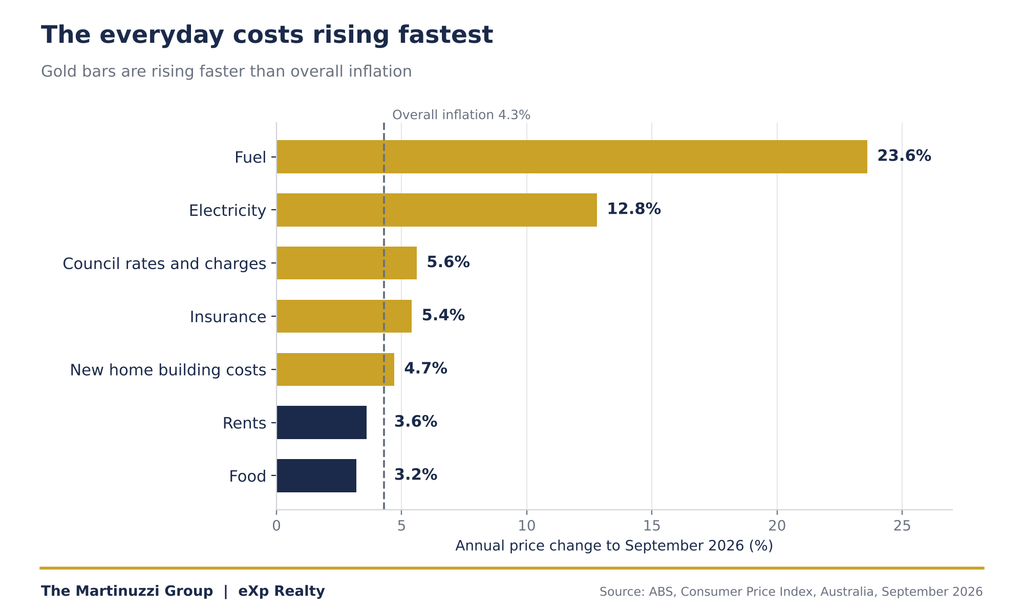
It is not just housing and fuel. Food prices rose 3.2% over the year, with meals out and takeaway the main contributor. Insurance rose 5.4%. Medical and hospital services rose 4.8%.
The figure that stood out most to me is the gap between essentials and everything else. The ABS separates spending into non-discretionary items, the things households need, and discretionary items, the things they can choose to cut back on. Over the past year, essentials rose 5.2%, while discretionary spending rose 3.2%. The costs families can’t easily avoid are the ones rising fastest.
The ABS measures inflation across the capital cities, so Brisbane is the closest guide for South East Queensland. Brisbane’s annual inflation came in at 4.4%, slightly above the national figure, with insurance and financial services up 5.0% and housing up 5.4%.
Why Most Economists Expect Another Rate Rise
The cash rate currently sits at 4.60% after four increases this year, in February, March, May and September. That is the highest it has been since 2011.
Following yesterday’s figures, market pricing reported by the ABC put the chance of another 0.25% rise next week at around 85%. KPMG’s chief economist Brendan Rynne suggested this data was the final piece the RBA needed to move again. RBA Deputy Governor Andrew Hauser also told a Senate estimates hearing yesterday that inflation remains “too high”.
So the consensus is clear, and I respect that. The RBA has a tough job to do.
Why I Think They May Hold
We have already had four rate rises this year, and it takes time for each one to flow through to household budgets. According to Canstar’s estimates, a borrower who started the year with a $600,000 loan and 25 years remaining is already paying around $364 more each month after four hikes. A fifth rise would add roughly another $92 a month on top of that.
I also think it is worth asking what is actually driving inflation right now. Much of it is coming from fuel, electricity, insurance and building costs. Higher interest rates won’t bring down world oil prices or bring back electricity rebates. They do add another bill for families who are already stretched.
I am not the only one who sees a case for waiting. Betashares chief economist David Bassanese pointed out that the RBA already moved early in September, so it may feel it has some room to watch how the economy responds and revisit the decision in December. To be fair, his base case is still a hike next week.
My view is simple. How much more pressure can households take? Everything seems to be getting more expensive, and another rate rise is the last thing families need right now. We will know on Tuesday afternoon.
What It Could Mean for Homeowners
Whichever way the RBA goes, it may be a good time to check where you stand. If you have a mortgage, it could be worth looking at your current rate, your repayment buffer and whether a conversation with your lender or broker makes sense. Small changes can add up over a year.
If you are thinking about upgrading, downsizing or selling in the next six to twelve months, understanding your property’s current position in the market can help you plan with more confidence, whatever happens with rates.
What It Could Mean for Sellers
Buyers are watching their borrowing capacity closely. If rates rise again, some buyers may find their budgets trimmed slightly, and many will become more careful about what they are willing to pay.
That makes strategy more important. Realistic pricing from the start, strong presentation and good timing can make a real difference when buyers are being more selective. With the lead-up to Christmas approaching, timing is worth thinking about now rather than later.
What It Could Mean for Buyers
If you are planning to buy, it may be worth having your pre-approval reviewed before Tuesday’s decision, so you know exactly where you stand. Lenders already assess loans with a buffer above current rates, but a change in the cash rate can still affect how much you are able to borrow.
On the other side, a more cautious market can sometimes mean less competition and more time to make decisions. Being prepared puts you in a stronger position either way.
The Sunshine Coast Angle
Here in the hinterland, many of these costs hit close to home. For families in places like Palmwoods, Woombye, Nambour and Mooloolah Valley, the car is often not optional, so higher fuel prices are felt every week. Electricity and insurance costs are also part of the everyday budget for local homeowners.
That is why I think local buyers and sellers are making more considered decisions at the moment. National headlines matter, but what really counts is how these pressures play out in your own suburb and for your own property.
Let’s Talk
If you are wondering what next week’s decision could mean for your property, it may be worth getting an updated opinion. A quick, no-pressure conversation can give you more clarity before making any big decisions. Feel free to reach out to me or the team at The Martinuzzi Group anytime.
Get in touch with us today and and let’s give you fantastic results that you deserve.
SUBSCRIBE to stay up to date with all the latest property insights and news.
Click Here to Subscribe
The Sunshine Coast Seller’s Guide to Choosing the Right Agent
Get Your Free Guide Here
Just Listed Your Home? Here’s What Happens Next (And How to Get Ready for a Great Result)
Download the Guide Here
Sources: Cotality Home Value Index and Monthly Housing Chart Pack (October 2026)