


Units or Houses: What the 2026 Tax Changes Mean for Property Investors
By Nicola Concato of Martinuzzi Group – eXp Realty | Sunshine Coast Real Estate
For years, the investment playbook was simple. Buy a well located house. Accept a loss in the early years. Claim the deductions. Then wait for capital growth to do the work.
That playbook has changed. Not because of market sentiment, but because Parliament changed the law. As a result, the old question of houses or units now sits underneath a much bigger one.
1. What actually changed
On 12 May 2026, the Government announced reforms to negative gearing and capital gains tax as part of the 2026-27 Federal Budget. The Treasury Laws Amendment (Tax Reform No. 1) Act 2026 then received Royal Assent on 26 June 2026. Both measures start on 1 July 2027.
Most commentary has focused on the first change. However, the second one reaches much further.

Negative gearing now applies only to new builds
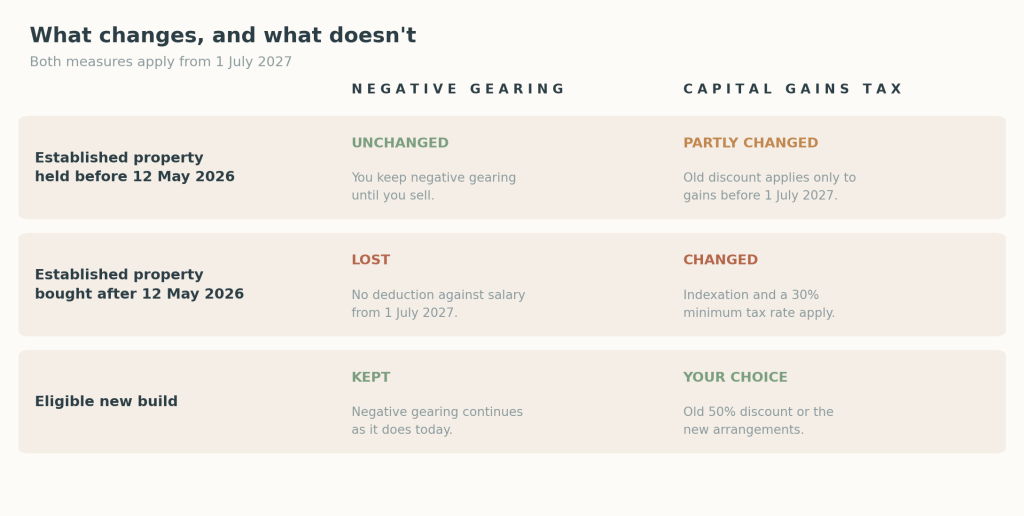
From 1 July 2027, you can only negatively gear a new build. If you held a property at 7:30pm AEST on 12 May 2026, the change does not touch you. This includes properties under contract but not yet settled. Those owners simply continue under the old rules until they sell.
For established property bought after that date, the picture shifts. You can no longer deduct net rental losses against your salary, wages or other non-property income. However, you do not lose those losses. Instead, you carry them forward and apply them against residential rental income or capital gains on residential property.
There is also an interim window. If you buy established property between 12 May 2026 and 30 June 2027, you can generally negatively gear it until the new rules start. After that, you cannot.
The capital gains tax discount is changing
Fewer people are talking about this one. Yet it affects far more investors.
From 1 July 2027, cost base indexation replaces the 50 per cent CGT discount for individuals, trusts and partnerships. A minimum 30 per cent tax rate on capital gains also applies.
The critical difference comes down to who it touches. The negative gearing change protects you if you bought before Budget night. The CGT change offers no such protection. Instead, it applies to gains that accrue after 1 July 2027, whatever date you bought.
So an investor who has owned a property since 2015 is not exempt. Their gain effectively splits in two. The old discount covers the portion that accrued before 1 July 2027, while the new rules cover everything after it.
If you buy an eligible new build, you can choose between the old discount and the new arrangements.
One more change worth knowing about
The same Act also restricts self managed super funds. Specifically, an SMSF can no longer use a limited recourse borrowing arrangement to buy residential property.
So if you have been planning a purchase through your fund, speak to your adviser first.
This section covers general tax changes only. Individual circumstances vary widely, so please seek advice from a qualified accountant before you act.
2. Why this reframes the whole question
Read together, the two changes do something the headlines have largely missed.
Negative gearing addressed the holding cost of a property. Meanwhile, the CGT discount addressed the eventual profit. The old strategy leaned on both at once. Now the system clearly favours new builds. They keep both concessions, while established stock loses both.
Of course, that does not automatically make new builds better investments. Purchase premiums, build quality, resale competition and rental performance all still apply. A tax concession has never rescued an overpriced property.
But the first question has certainly changed. You are no longer simply choosing between a unit and a house. Instead, you are asking which property delivers a return that stands up without a deduction propping it up.
In short, cash flow matters more than ever
3. The case for units
In the right location and the right complex, units offer real advantages.
First, they usually cost less than houses in the same suburb. As a result, you can enter a better market, stay closer to work and amenities, or buy two cheaper properties instead of one expensive one.
Second, units often produce a higher gross rental yield. This happens because the gap between unit rents and house rents is narrower than the gap between their prices.
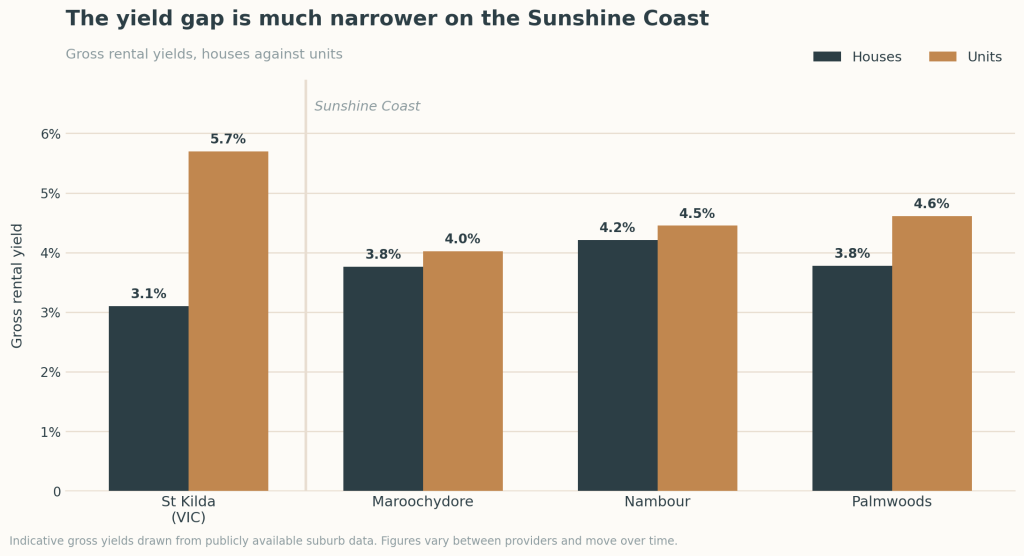
St Kilda shows this clearly. For the twelve months to June 2026, the median unit sold for around $515,000 on a gross yield of 5.7 per cent. Meanwhile, the median house sold for around $1.525 million on a yield of just 3.1 per cent.
That does not make every St Kilda apartment a good buy, though. Large towers have supplied the market with defective balconies, expensive lifts and body corporate budgets of considerable ambition.
So the opportunity is not simply to buy a unit. It is to buy the right kind of unit.
4. What to look for in a unit
If you want cash flow and long term resale appeal, established units in smaller complexes generally hold up best. Here is what to check.
Keep the complex small
Roughly six to twelve units strikes a good balance between shared costs and scarcity.
Smaller complexes usually appeal more to owner occupiers than large investor heavy developments. They also tend to have fewer competing properties listed at the same time.
Still, twelve is not a rule. A quality property in a complex of fourteen beats a poor one in a complex of eight.
Watch the shared facilities
Pools, gyms, lifts, rooftop areas, security systems and concierge services all push up body corporate costs.
Some premium markets support them. The real question is whether tenants will pay enough extra rent to cover the expense. By contrast, a well maintained walk up without lifts or recreational facilities is often far cheaper to own.
Check the body corporate finances
Low fees look attractive. However, fees can also be too low.
A body corporate that has collected very little may simply be postponing maintenance. Then, when roofing, drainage, painting or structural repairs finally need attention, owners face a hefty special levy.
In Queensland, you can request access to body corporate records and check levies, financial matters and planned works. Review the administrative fund, the sinking fund forecast, insurance, recent meeting minutes and any major works on the horizon.
Ultimately, you are not hunting for the lowest fees. You are looking for a well run complex with no large, poorly funded problem approaching.
Look for owner occupiers and genuine demand
Owner occupiers usually take a longer term interest in a building. Because of this, complexes with a high owner occupier share often have better maintained common areas, steadier decision making and stronger resale appeal.
Rental demand matters just as much, and it should come from several sources rather than one. Look for access to employment centres, public transport, hospitals and universities, shops, beaches and parks, established schools and a walkable town centre.
Demand that rests on one temporary project or one big employer is fragile. In fact, a unit in a strong location can easily outperform a larger property somewhere renters have little reason to be.
Find the property that stands apart
Within a complex, small differences move rent and resale value more than people expect.
Natural light, secure parking, outdoor space, a good outlook, a workable floor plan, storage, privacy and position all matter.
Put simply, a scarce and desirable property is easier to rent and easier to sell. A generic apartment surrounded by hundreds of near identical alternatives is neither.
5. The land question
One of the strongest arguments for houses has always been land. Buildings age and need maintenance, whereas well located land is finite.
Even so, it is a mistake to assume units have no link to land at all. When you buy a strata titled property, you own your individual lot and share an interest in the common property.
In a small complex of six or eight units on a valuable site, each owner may hold a more meaningful stake in the underlying land than an owner in a tower of 150 apartments. That can matter if a developer eventually wants the whole complex. An older block of six on a large parcel in a high density area may be worth more as one development site than as six apartments.
Still, treat this as a possible bonus rather than a strategy. Collective sale rules vary considerably between states, and the process is rarely quick.
Before you place any value on redevelopment potential, check the site area, zoning, permitted height and density, lot entitlement, heritage restrictions, access and frontage. After all, a large theoretical share of land helps nobody if the site cannot be redeveloped or the owners cannot agree.
6. Why houses still hold their appeal
Units may offer stronger cash flow at a lower entry price. However, houses offer things that are hard to reproduce.
You keep control
As a house owner, you decide when the exterior gets painted, whether to install solar and whether to allow a pet. There is no body corporate and no regular fees.
That said, the property is not free to maintain. Roofing, fencing, drainage, painting, gardens and structural repairs all sit with you.
You can create value yourself
This is the real advantage, and units rarely offer it.
A dated house may have room to lift both rental income and market value. Think kitchens and bathrooms, extra bedrooms, outdoor entertaining, a home office or simply a smarter floor plan. Subject to local planning rules, some properties also allow a granny flat, which can add a second income stream. A larger block may even allow subdivision, a duplex or townhouses.
Admittedly, the words “subject to council approval” are doing considerable work in that last sentence. So verify minimum lot sizes, overlays, frontage rules, easements, servicing, flood and bushfire constraints and infrastructure charges before you assign any value to it.
The key, either way, is to buy where the improvement creates more value than it consumes.
7. A Sunshine Coast perspective
The same budget behaves differently depending on where you spend it. The Sunshine Coast shows why national commentary needs translating before you act on it.
The yield gap is narrower here
The national case for units leans heavily on the yield gap. In some inner city markets that gap is wide, because the price difference far outstrips the rent difference.
On the Sunshine Coast, it is much narrower. Across Maroochydore, Nambour and Palmwoods, gross yields on houses generally sit between roughly 3.5 and 4.2 per cent. Units sit between roughly 4 and 4.6 per cent.
That gap is real, and it still favours units. Even so, it is closer to half a percentage point than the two or three points seen elsewhere.
Consequently, you cannot simply import a conclusion formed in Melbourne or Sydney. The cash flow advantage here is genuine but modest, which means ongoing costs matter proportionally more. A body corporate fee that a 5.7 per cent yield absorbs comfortably will eat a meaningful share of a 4.2 per cent one.
Watch the supply pipeline
Maroochydore is midway through a major development cycle. A new CBD, significant infrastructure investment and well over a thousand apartments are all in the pipeline ahead of 2032.
Long term, that investment is a genuine reason for confidence. In the shorter term, however, it means anyone buying into a large, new, investor heavy complex may face a great deal of very similar stock at both letting and resale.
The hinterland is a house market
The question does not apply evenly across the region.
In much of the hinterland, the unit market is very thin. Palmwoods recorded around 136 house sales against six unit sales over a recent twelve month period. In suburbs like that, you are not really choosing units against houses. You are choosing which house, on which block, with what future flexibility.
Where the unit question genuinely lives is the established coastal strip. Small walk up complexes near the beach, the town centres and the transport spine. Many are forty or fifty years old, few have lifts or pools, and they sit on land that has appreciated considerably.
Crucially, they are also increasingly scarce, because very little new stock of that kind gets built. That scarcity is the argument for them, and it differs completely from the argument for a new apartment in a tower.
8. Look past the gross yield
A high advertised yield looks attractive. Still, the number that matters is what you keep.
For a unit, expect body corporate fees, council and water rates, property management, landlord insurance, repairs, the occasional special levy, vacancy and loan interest. For a house, expect most of the same. On top of that, you cover exterior maintenance, roofing, fencing, landscaping and drainage in full.
Allow for transaction costs, and keep a cash reserve. A property that only works when it is occupied fifty two weeks a year and nothing breaks is not a strategy. It is optimism wearing a calculator.
9. So, which is better?
There is no universal winner, and anyone offering one is selling something.
The tax changes are pushing investors to be more selective, and that is not a bad outcome. Cash flow can no longer sit quietly in the background while you wait for capital growth. Equally, chasing yield without regard for quality, location, supply and resale demand ends just as badly.
Units may well become a more compelling vehicle, particularly boutique complexes with low costs and genuine location advantages. Meanwhile, houses will keep offering what units cannot: control, land and the chance to create extra value yourself.
So the real question is not “should I buy a unit or a house?”
It is this. Which individual property gives me the strongest combination of cash flow, quality, scarcity and long term opportunity for the budget I have?
That is the decision worth getting right.
If you are weighing up an investment purchase on the Sunshine Coast, or working out what these changes mean for a property you already own, we are always happy to talk it through. No pressure and no obligation, just an honest read on where you stand.
Get in touch with us today and and let’s give you fantastic results that you deserve.
SUBSCRIBE to stay up to date with all the latest property insights and news.
Click Here to Subscribe
The Sunshine Coast Seller’s Guide to Choosing the Right Agent
Get Your Free Guide Here
Just Listed Your Home? Here’s What Happens Next (And How to Get Ready for a Great Result)
Download the Guide Here
This article contains general information only and does not constitute financial, taxation or legal advice. Property and taxation rules vary according to individual circumstances and may change. Please obtain independent advice from a qualified accountant, financial adviser, solicitor, conveyancer and relevant property professionals before you make an investment decision. Market figures cited come from publicly available data and are current as at the date of publication.
Sources: Australian Taxation Office, Tax reform: Boosting home ownership. Treasury Laws Amendment (Tax Reform No. 1) Act 2026 (Cth), Federal Register of Legislation.