


Australia’s Growth Cycle Has Turned for the First Time Since March 2023
By Leigh Martinuzzi of Martinuzzi Group – eXp Realty | Sunshine Coast Real Estate
You have probably seen the same line this week on every property page. Australia’s boom is over. Domain’s June Quarter 2026 House Price Report has driven the story, and the media has jumped on it hard.
But a national headline rarely describes your local market. This week is a good example of why. If you own a home in Palmwoods, Woombye, Nambour, Mooloolah Valley, or anywhere across our hinterland, the story on your feed is not the story on your street.
Here is how I have been reading it, and what it means for us locally.
The national numbers are real, but the fall is not evenly spread
According to Domain’s latest figures, house prices across the capital cities fell 1.4% for the June quarter. Unit prices fell 1.2%. That ends the longest stretch of unbroken quarterly growth since 2012 to 2015. Dr Nicola Powell, Domain’s Chief of Research, points to a familiar mix. Higher interest rates. Affordability pressure. Buyers who feel less confident than they did a year ago.
The story gets more interesting when you look under the surface.
Sydney led the fall this quarter, with house prices down 3.3%. That is the sharpest quarterly drop for the city since 2022. Melbourne fell 3.1%, its worst result in nearly four years. Canberra also slipped. Together, those three markets carry enough weight to drag the national average into the red.
Five other capitals told a different story entirely.
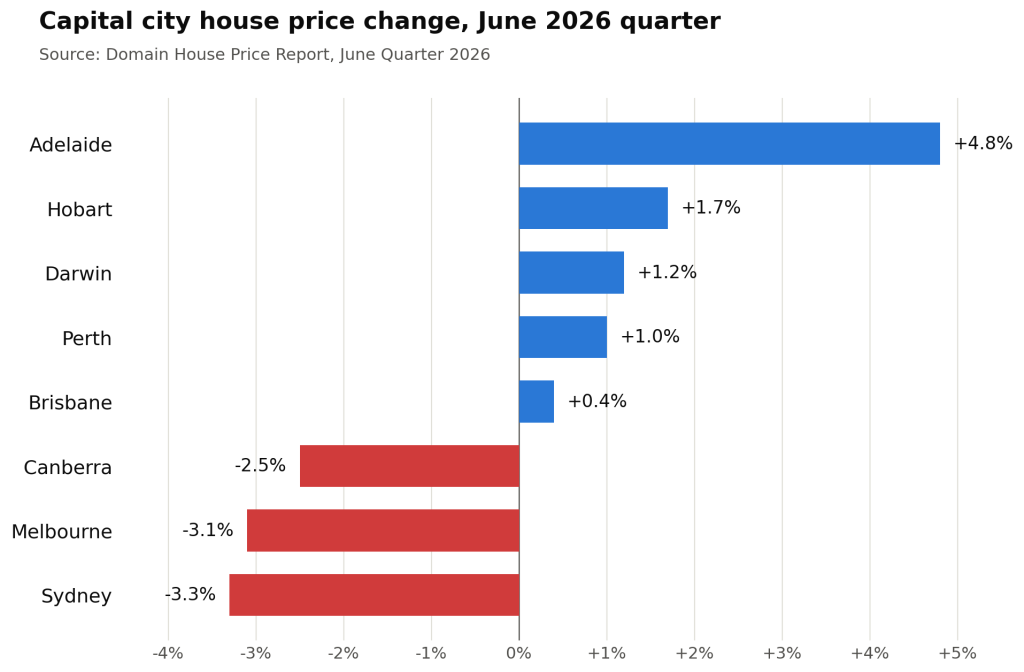
Adelaide surged 4.8%. As Domain pointed out, it has now quietly overtaken Melbourne as Australia’s fourth most expensive capital. Perth added another 1.0% for the quarter. Annual growth there sits at 22.5%, still the strongest in the country. Brisbane grew 0.4% and hit a new peak of $1.21 million. Hobart and Darwin also ticked up.
The two-speed market keeps widening
This gap is exactly the point Michael Yardney keeps making. His long-running argument is simple. Australia has never been one property market, and this week proves it again. Cotality’s most recent chart pack backed it up from a different angle. Capital city values fell 1.3% over the June quarter. But regional markets across the country actually rose 1.1%. The correction is real. It just sits in the places where affordability has stretched the longest.
The market has shifted for buyers, and you can feel it on the ground
Every homeowner and seller should watch this next section closely. The tone has changed most here.
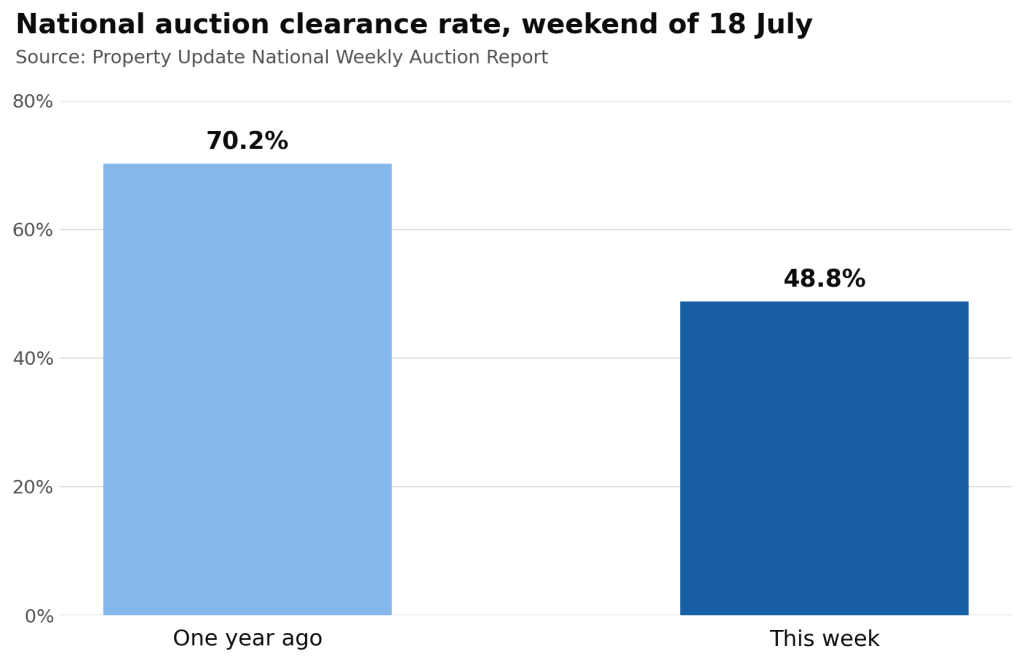
National auction clearance rates have fallen to their lowest level since April 2020. The most recent weekly report on Property Update put the national figure at 48.8%. A year ago, the same week cleared 70.2%.
Brisbane is supposed to lead the Queensland resurgence. But it cleared just 29.7% of its auctions last weekend, well below the 54.5% it managed a year earlier. That is a genuine softening. More sellers around the country are now choosing private treaty over public auctions. Cotality has flagged the shift too. The share of new listings going to auction has fallen from nearly 45% in November last year to just over 30% by June. Sellers are voting with their feet.
Buyers are patient, and it shows in every campaign
None of that is disaster territory. But it is a genuine reset. Buyers who felt urgency 18 months ago now feel patient. They take longer to think, negotiate more firmly, and no longer feel pressure to compete on the day.
Cotality also reported some useful supporting numbers. The median vendor discount across combined capital cities has widened to 3.6%. Total capital city listings are now 7.7% higher than they were a year ago. Homes are still selling. They are just selling with more competition on the shelf and less momentum behind them.
The rate story is not finished yet
The RBA held the cash rate at 4.35% at its June meeting. The next decision falls on 10-11 August. It is worth remembering how we got here. The RBA cut rates three times through 2025. It then lifted them three times in the first half of 2026. That unwound the earlier cuts and returned the cash rate to its previous peak. Every one of those moves has quietly reshaped what buyers can borrow.
The odds of one more rise before the end of the year have crept up in recent weeks. Stronger employment numbers and firmer global energy prices are part of the reason. A recent Property Update analysis noted that another quarter-point rise typically trims maximum borrowing capacity by 4 to 5%. That may sound small. But for a buyer already close to their limit, it is often the difference between making an offer and walking away.
If your pre-approval predates the last rate rise, refresh it before making an offer. That is the most practical piece of advice I can give buyers right now.
Queensland is holding its ground, but we are not immune
I want to be honest about our local position, because I think that lands better than being cheerful.
Yes, Queensland is one of the better positioned markets in the country. Brisbane hit a new house price peak in June. Annual growth remains in double digits according to Domain. Sunshine Coast values are still growing at healthy rates on local agency data. Median house prices sit somewhere between $1.26 million and $1.29 million, depending on the source. Population growth into South East Queensland remains one of the strongest structural stories nationally. The state added roughly 92,000 residents over the year to December 2025.
But affordability is now the pressure point
The softness in Brisbane’s auction market this week is worth respecting. And the affordability point Michael Matusik keeps raising in his Missive matters here more than most places. His own affordability estimates put the Sunshine Coast among Australia’s least affordable larger markets. We sit in the same conversation as the Gold Coast and Sydney. Lifestyle demand for our region has not faded. But the pool of buyers who can service prices at this level has shrunk in the last two years. That quietly reshapes buyer behaviour at every price point.
Our market is not defying gravity. It is simply calmer, more selective, and more sensitive to price and presentation from day one.
What it means if you are thinking of selling
If you plan to sell in the next three to six months, three things matter more now than they did in early 2024.
Launch pricing is your biggest decision
Launch pricing has become the most important decision in any campaign. Buyers now have more homes to compare and more time to think. An ambitious price at launch gets punished harder than it used to. And once a property has sat for four or five weeks, the perception of value drops with it. No amount of later adjustment fully recovers that ground. Getting the number right in the first fortnight matters enormously.
Presentation is doing more work than before
Presentation is the second lever. When buyers have choice, they favour the home that feels ready to move into. Small investments in styling, minor cosmetic work, and professional photography now pay for themselves. That was not always the case in 2024, when everything sold on momentum.
Method of sale matters more than it used to
Method of sale is the third. Private treaty is quietly becoming the more considered choice across many pockets of the Sunshine Coast. That is especially true where buyer pools are narrower, or where finance clauses are likely. Auction still works well for scarce, in-demand property with real bidder depth. But it now needs to be earned, not assumed.
What it means if you are thinking of buying
For buyers, this is a more comfortable market than it was 18 months ago. You have more time to inspect. There is more stock to choose from. And there is genuine room to negotiate. You will not get squeezed by five other bidders at an open home next Saturday morning.
That said, do not sit around waiting for a broad-based fall in Sunshine Coast prices. The national correction is not playing out in our region right now. And the fundamentals that support local values are still very much in place. Lifestyle demand. Migration into South East Queensland. Constrained supply.
Get your finance in order, particularly with the RBA so close to another meeting. Know your numbers. And when you find a home that suits you, be ready to move on it.
The cleanest summary of this week I have read came from Yardney. He framed the shift as a return to a normal market, not the beginning of a downturn. That aligns with how it feels on the ground here. The easy, everything-rising phase of the cycle is behind us. What comes next is a slower, more considered market. Local knowledge, sensible pricing, and strong preparation will matter more than they have in years.
That is not bad news. It is just a different market to the one everyone got used to. And in that kind of market, the value of proper advice tends to quietly go up.
If you would like a clear read on where your property sits right now, feel free to reach out. Same if you are weighing up whether now is the right time to make a move. Happy to have a no pressure chat and give you a straight answer.
Get in touch with us today and and let’s give you fantastic results that you deserve.
SUBSCRIBE to stay up to date with all the latest property insights and news.
Click Here to Subscribe
The Sunshine Coast Seller’s Guide to Choosing the Right Agent
Get Your Free Guide Here
Just Listed Your Home? Here’s What Happens Next (And How to Get Ready for a Great Result)
Download the Guide Here